Fengjiao presenting & Meiliu organising a session at SDSS, 04-05 Dec, 2025
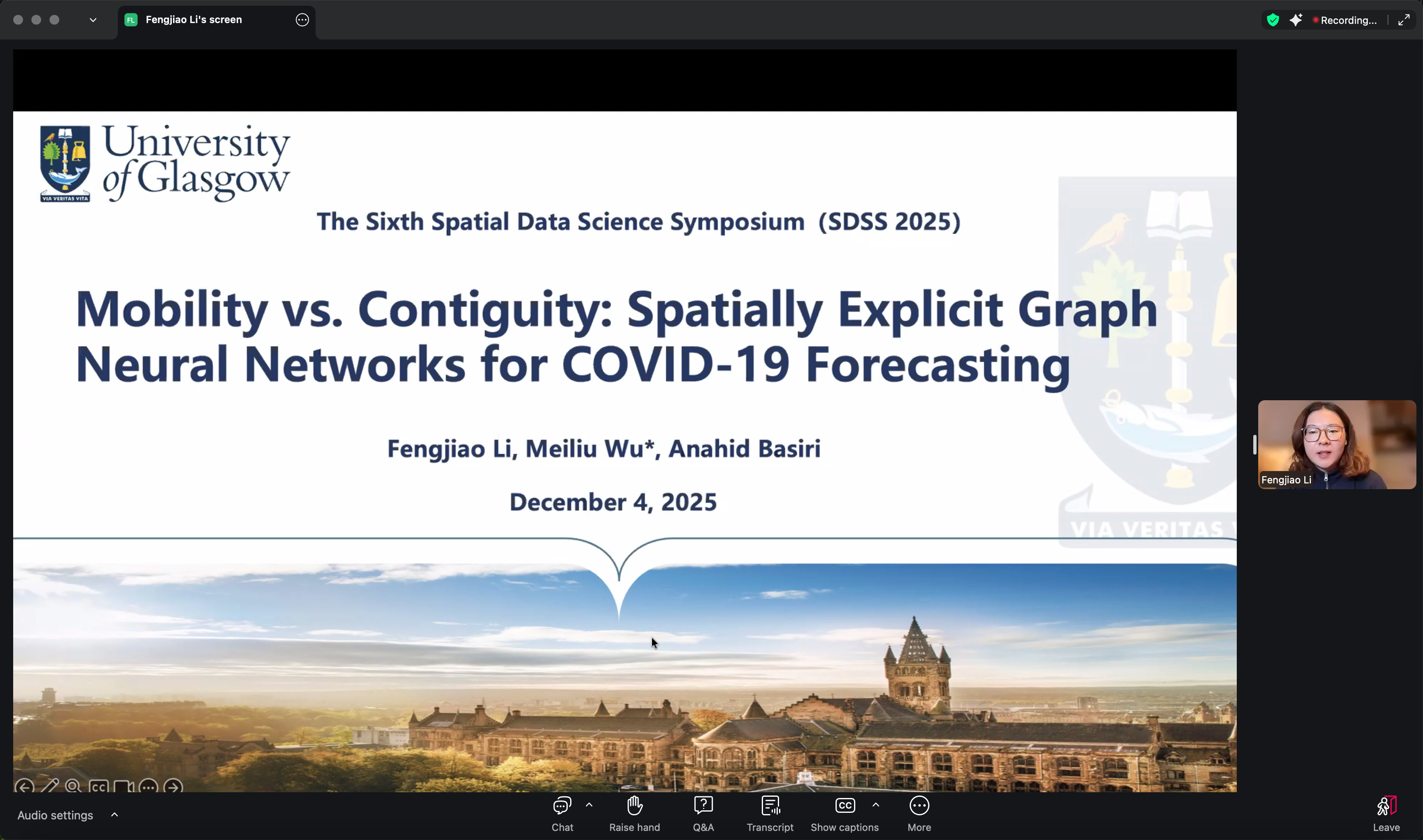
This week, Fengjiao is presenting her research “Mobility vs. Contiguity: Spatially Explicit Graph Neural Networks for COVID-19 Forecasting” at the Sixth Spatial Data Science Symposium, December 4-5, 2025. This is her first time to present in an academic conference. Good job, Fengjiao! I’m so proud of you!
We published a conference proceeding (full paper), and please feel free to check it out if of any interest!
- Li, F., Wu M.@, & Basiri, A., 2025. Mobility vs. Contiguity: Spatially Explicit Graph Neural Networks for COVID-19 Forecasting. The 6th Spatial Data Science Symposium (SDSS 2025). DOI: https://doi.org/10.5281/zenodo.17660772
Also, I am thrilled to have had the opportunity to organise and chair a session on “Trustworthy (Geo)AI for Population Health” with the other four wonderful colleagues:
- Dr Calvin Tribby, City of Hope
- Dr Ismail Saadi, University of Cambridge
- Dr Yanjia Cao, University of Hong Kong
- Dr Yuchen Li, University of Leeds
A huge thank-you to each attendee listed below for your wonderful contributions to our SDSS session, which was genuinely enjoyable, and it was a real pleasure to see such complementary work come together in one (virtual) room.
1) Presenters
- Dr Kenan Li, Saint Louis University
- Dr Jue Yan, Brown University
- Dr Xianghui Zhang, University of Liverpool
- Dr Ye Tian, University College Dublin
2) Panellists (Q&A discussants)
- Dr Mingyu Zhu, University of Glasgow
- Dr Yao Li, University of North Carolina at Charlotte
- Fengjiao Li, University of Glasgow
- Zhihao Liu, University of Hong Kong
We covered a remarkable range of topics:
- Dr Kenan Li showed how the STAGE framework brings together spatio-temporal attention and graph-based mobility embeddings to reveal interpretable patterns in recovery, health-care access, and vulnerability after extreme events.
- Dr Jue Yang demonstrated how GeoAI can operationalise the 3-30-300 framework (very interesting!), linking street-level greenery and tree canopy to school performance and equity in children’s learning and health.
- Dr Xianghui Zhang unpacked how both green-space accessibility and utilisation jointly shape common mental health diagnoses, using mobile-phone traces, environmental data, and primary care records to reveal synergistic effects.
- Dr Ye Tian illustrated how 2D and 3D urban form influences air pollution distributions, combining mobile air-quality monitoring in Glasgow with machine learning to better understand exposure in complex urban environments.
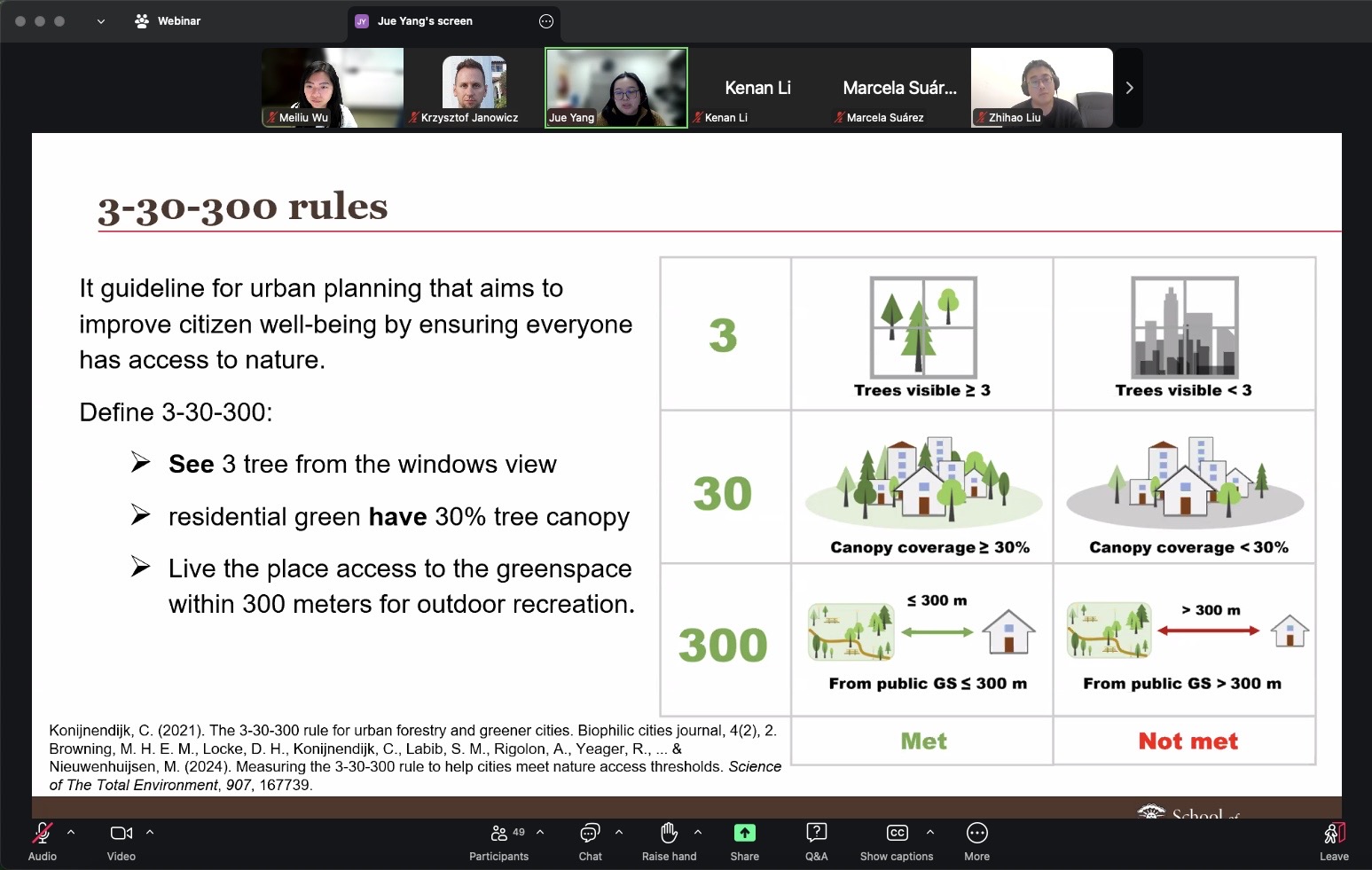
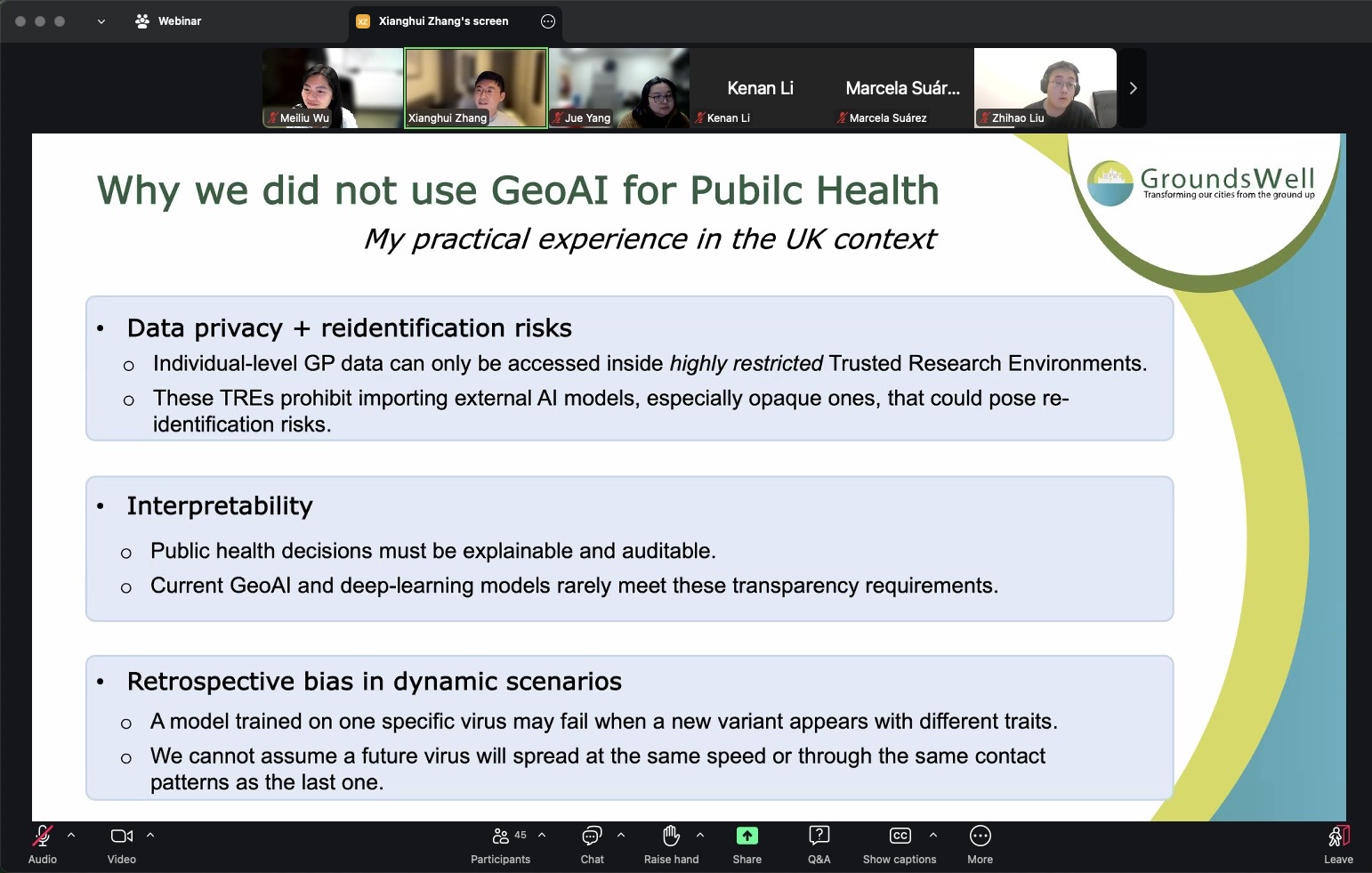

Taken together, these talks highlighted many of key ingredients: spatially explicit models, multimodal data (mobility, environment, air quality, health records), interpretability and transparency, equity-aware measurement, and real-world relevance for planning and policy.
Looking ahead, it feels like we are collectively circling an important agenda:
- How can we design GeoAI models that are both spatially explicit and interpretable for health decision-makers?
- How do we measure and mitigate bias in geospatial and population-health datasets (e.g., uneven sensor coverage, mobility selection, environmental inequities)?
- How can we embed uncertainty, fairness, and reproducibility into our pipelines, from data curation to model deployment?
It was truly a joy to learn from all of talks and discussions, and I hope this is the beginning of a longer-term conversation and collaboration network around trustworthy (Geo)AI for population health!
Lastly, special thanks to the Local Organization Committee below! I truly appreciated the warm welcome and the thought-provoking conversations with such curious and enthusiastic colleagues and students!
Vanessa Brum-Bastos Program Chair University of Canterbury
Yingjie Hu Program Chair University at Buffalo
Ivan Majic Program Chair Graz University of Technology
Grant McKenzie Program Chair McGill University
Marcela Suarez Program Chair University of New Mexico
Krzysztof Janowicz General Chair University of Vienna